Few topics in software engineering generate as much noise as monoliths vs microservices.
Microservices are praised as “modern,” “scalable,” and “enterprise-ready.”
Monoliths are often dismissed as “legacy” or “technical debt.”
But here’s the reality most blogs won’t tell you:
👉 Most products fail because of bad business decisions, not because they chose the wrong architecture.
Architecture is a tool, not a badge of honor.
This article breaks down what monoliths and microservices really are, where each one shines, where they fail, and how to choose without hype.
First, Let’s Kill the Myth
Microservices are not an upgrade to a monolith.
They are a trade-off.
Every architectural decision buys you something, and costs you something else.
Senior engineers don’t ask:
“What’s the best architecture?”
They ask:
“What problem are we solving right now?”
What a Monolith Actually Is (And Isn’t)
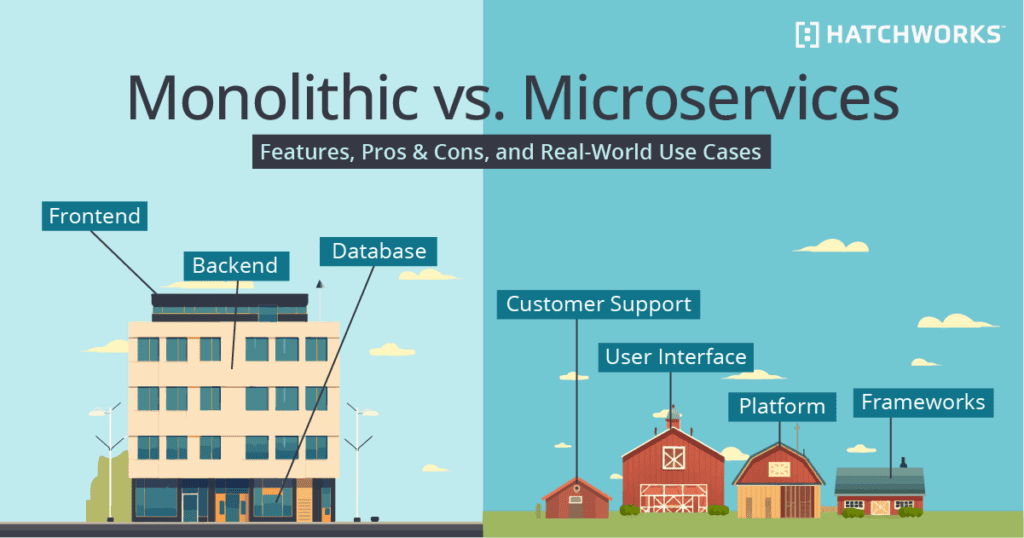
A monolith is a single deployable application where:
- Business logic lives in one codebase
- Components are tightly integrated
- The system is deployed as one unit
What a monolith is not:
- Automatically messy
- Unscalable
- Poorly designed
A well-structured monolith can:
- Scale to millions of users
- Be clean, modular, and testable
- Outperform poorly designed microservices
The problem isn’t monoliths.
The problem is unstructured monoliths.
What Microservices Actually Are
Microservices split a system into independently deployable services, each:
- Owning a specific business capability
- Communicating over the network (HTTP, gRPC, messaging)
- Deployed and scaled separately
They shine when:
- Teams are large
- Domains are clearly separated
- Operational maturity exists
But microservices add complexity by design.
The Hidden Cost of Microservices
Microservices look elegant on architecture diagrams.
In practice, they introduce serious overhead.
What you gain:
- Independent scaling
- Team autonomy
- Fault isolation
What you pay:
- Network latency
- Distributed debugging
- Service discovery
- Monitoring complexity
- DevOps overhead
- Data consistency challenges
If your team isn’t ready, microservices slow you down instead of speeding you up.
Why So Many Teams Choose Microservices Too Early
Most teams don’t move to microservices for the right reasons.
Common motivations:
- “Netflix uses it”
- “It looks modern”
- “Investors expect it”
- “Our monolith feels messy”
But messy code isn’t an architecture problem.
It’s a discipline problem.
Splitting bad code into services just gives you distributed bad code.
When a Monolith Is the Right Choice
A monolith is usually the best option when:
- You’re an early-stage startup
- Your team is small (1–10 engineers)
- The product is still evolving
- Requirements change frequently
- Speed matters more than theoretical scale
Monoliths excel at:
- Fast development
- Simple debugging
- Lower operational costs
- Clear data consistency
Many successful products stayed monolithic far longer than you think.
When Microservices Make Sense
Microservices are justified when:
- You have multiple teams working independently
- Your domain is clearly split (billing, auth, search, etc.)
- Different parts of the system scale differently
- You have strong DevOps practices
- You can afford operational complexity
Microservices are an organizational solution, not just a technical one.
They shine when Conway’s Law works for you, not against you.
The Transitional Architecture Most Teams Ignore
There’s a middle ground that doesn’t get enough attention:
👉 The Modular Monolith
A modular monolith:
- Lives in one codebase
- Has strict internal boundaries
- Separates domains clearly
- Can be split into services later
This approach gives you:
- Simplicity now
- Flexibility later
- A clear migration path
Senior teams often design monoliths as if they might become microservices someday—but don’t rush the split.
Scaling Is Not Just Traffic
Many teams choose microservices thinking:
“We’ll need this when we scale.”
But scaling isn’t just users.
You also scale:
- Teams
- Processes
- Communication
- Failures
If your team struggles to maintain one system, multiplying systems won’t fix it.
Decision Framework: Ask These Questions First
Before choosing an architecture, ask:
- How many engineers will work on this in 12 months?
- How often will requirements change?
- Do we have DevOps maturity?
- Are our domains clearly defined?
- Can we afford increased operational complexity?
If these answers are unclear, default to simpler architecture.
Complexity should be earned, not assumed.
Real-World Truths Senior Engineers Learn
- You can refactor a monolith more easily than a distributed system
- Premature microservices are harder to undo than a monolith
- Most performance problems aren’t architectural
- Clean boundaries matter more than deployment style
The best architecture is the one that:
- Solves today’s problems
- Doesn’t block tomorrow’s growth
- Keeps teams productive
Final Thoughts
Monolith vs microservices isn’t a battle.
It’s a timing decision.
Monoliths help you find product-market fit.
Microservices help you scale organizations.
Choose based on:
- Your team
- Your product
- Your maturity
Not hype.
Because the most expensive architecture is the one that slows you down when you can least afford it.











Comments (0)